The Great Migration from the Monongahela Valley
American RustThe Great Migration from the Monongahela Valley names the movement of people away from a region devastated by the steel industry’s decline, as well as the upheaval left among those who stayed. In the novel, migration promises escape but often delivers only a new form of insecurity: jobs disappear, families are divided, and return becomes part of the story.
Industrial collapse and its reach
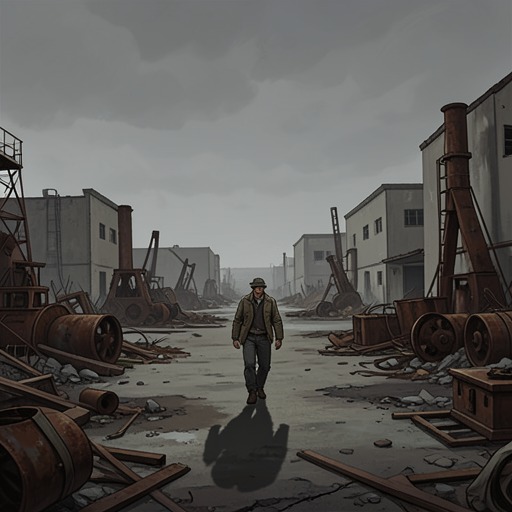
For a century, the Valley had been a center of steel production; by the time Isaac English and Billy Poe were born, it had lost 150,000 jobs. The mills had supported a broad industrial network, including tool-and-die shops, specialty-coating businesses, and mining-equipment makers. When the steel plants closed, that connected economy contracted with them, leaving many towns unable to afford basic services and some without police. The closure of Buell’s mill, followed by its partial dismantling, made the change visible in a landscape where industrial buildings stood abandoned and overgrown.
The novel links this decline to decisions about investment as well as to the loss of work. Henry English recalls that Penn Steel had not invested in its factories for fifteen years, while German and Japanese producers had modernized their plants. His recollection complicates explanations that blamed unions or labor costs alone: the region’s industrial failure was also tied to companies’ failure to reinvest. The consequences extended beyond the people directly employed in the mills, because the industries and services built around steel depended on the same economic system.
Routes out and the promise of elsewhere
Bud Harris remembers the movement away from the Valley as a migration with uncertain destination. Thousands of people went to Texas hoping to find work on oil rigs, but those jobs were scarce; some migrants ended up broke and unemployed in places where they knew no one. Others simply disappeared from the communities they had left. Harris had seen steelworkers’ wages fall from thirty dollars an hour to four dollars and fifteen cents, a measure of how sharply the region’s old basis for family security had eroded.
The contrast between departure and staying is not presented as a simple choice between ambition and resignation. Grace Poe recalls wanting to leave, but her father directed her into mill work after high school. She met Virgil Poe on the rolling line, married, and began college while raising a child; layoffs ended her schooling before she completed her associate degree. When work vanished, the family waited for mills to reopen, but closures continued. Her history shows how industrial contraction could narrow a person’s options before migration was even considered.
Families, homes, and constrained choices
The economic crisis reached into housing and household survival. Grace and Virgil’s trailer went into foreclosure, but local protests against sheriff’s sales helped bring a moratorium that eventually became law. The family kept the trailer and relied on food-bank supplies and poached deer; for two years, venison was their main food. Virgil later completed job training in robotics, but the anticipated positions never appeared, and a subsequent job at a barge-making plant ended when that plant closed too.
For Grace, leaving remained difficult to calculate. Men went to Houston, New Jersey, and Virginia, sometimes living six to a motel room and sending money home, yet many returned. Staying poor among familiar people could seem preferable to becoming broke among strangers. The novel sets this personal ambivalence against the region’s physical decline: Brownsville’s downtown is largely abandoned, while a new highway north toward Pittsburgh carries almost no traffic. In the southern Mon Valley, a house that might be worth two million dollars in Boston or Greenwich might bring only forty thousand. Such details make migration inseparable from the unequal value assigned to places and from the limited resources available to those trying to start over.
A region altered, not emptied
The movement away did not mean that the Valley’s story ended. Harris observes that the population was growing again even as incomes fell, municipal budgets shrank, and infrastructure went without investment for decades. The resulting towns faced small-town budgets alongside big-city problems; the prospects available to young people remained limited, and even office work increasingly required college education. Migration thus appears alongside continued residence, return, and local hardship rather than as a clean exodus.
The Valley’s landscape holds both industrial history and its aftermath. From the rail tracks, Isaac sees the remains of mills and remembers the crowds of workers leaving the billet mill at shift change, including his father before an accident changed the family’s life. The train line also offers Isaac a route away from Buell toward Pittsburgh and, ultimately, California. His attempted departure echoes the larger movement without making his individual journey identical to it: the same region can be both a place to escape and a home whose losses continue to shape those who leave.